

Alan Pope
39 posts

Snapcraft is our delightful tool for building snaps. It’s not the only way to build them, but it’s certainly a popular one. A benefit of Snapcraft is that typically a developer can configure the packaging definition once, and not have to update it for a long time. Snapcraft will keep cranking out releases, via CI
This is a guest post authored by Dani Llewellyn. It was originally featured on her blog, we’re reproducing it here with Dani’s permission. Dani is an active member of the WordPress, WSL, Ubuntu and Snapcraft communities. Thanks Dani! Recently there was an announcement from Ubuntu that the desktop team are working on a replacement for

Snaps are designed to be self-contained packages of binaries, libraries and other assets. A snap might end up being quite bulky if the primary application it contains has many additional dependencies. This is a by-product of the snap needing to run on any Linux distribution where dependencies cannot always be expected to be installed. Thi

Branches are an under-used but important feature of the Snap Store publishing capabilities. Indeed as I’m writing this post, I’ve never had a need to use the feature, and I’ve been publishing snaps for four and a half years. Let’s fix that! Start with acorns The rationale for branches is simple. Each snap in the

I’m celebrating nine years at Canonical, and coming up on 15 years since I started contributing to Ubuntu in the community. It’s been quite the ride, helping build, support and advocate for the most popular Linux desktop, and most used Linux distribution in the cloud. Over those years, we’ve strived to make it easy for

The Snap Store has been designed to enable upstream developers and enthusiastic community contributors to publish snaps. As with most Linux packaging solutions, the wider community are often responsible for starting and maintaining software packages. This is a double-edged sword, especially for humans with limited life spans and other shi

You’d think we would be running out of terrible/great (delete as applicable) 80s songs to try and shoehorn into the titles of these blog posts. Turns out, not quite yet! “How can I help?” is a phrase often used in Open Source projects by enthusiastic users and developers. There are a lot of moving parts

Broadly speaking, most snaps in the Snap Store fall into one of two categories, desktop applications and server daemons. The graphical applications such as Chromium and Spotify use desktop files, which ensure they can be opened on demand by any user via a menu or launcher. The server applications such as NextCloud and AdGuard-Home typical

With a smart phones in their pocket, most people don’t bother carrying a traditional camera anymore. For most, the single, double or even triple cameras on modern phones are great for making memories. Many Android and some iOS users have chosen to store their photos in the free or paid Google Photos service. In the

Following up on the previous example of building a rust and C based snaps, I thought we’d take a look at bundling a Java application as a snap. In this example we’ll use an open source game called “Shattered Pixel Dungeon“. It’s a little more complex than some more common snaps, which helps highlight some

There’s plenty of official documentation which details how to create snaps. We live in the copy/paste generation though. So lets walk through a real-world example you can use as a template, or selectively yoink sections from. This is the first in a series of posts which break down how to build snaps based on published

The third Linux Application Summit (LAS) kicks off this week in Barcelona, Spain. Formerly organised under the GNOME project, known as Libre Application Summit, the new LAS is a joint effort between the KDE and GNOME projects. The aim of the conference is to encourage the growth of a vibrant Linux application ecosystem. Canonical are
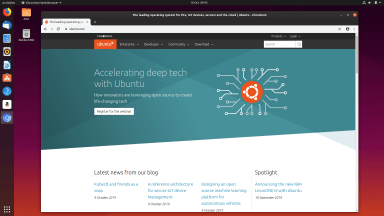
We have recently announced that we are transitioning the Chromium deb package to the snap in Ubuntu 19.10. Such a transition is not trivial, and there have been many constructive discussions around it, so here we are summarising why we are doing this, how, and the timeline. Why Chromium is a very popular web browser,

For many, watching other people play games has long taken over from TV as the favoured source of entertainment content. As a creator, whether you stream via YouTube, Twitch.tv or Mixer, Open Broadcast Software (OBS) Studio is the swiss-army knife to do it. The OBS snap makes this a breeze, whichever Linux distro you’re playing

Depending on the audience, the discussion of software packaging elicits very different responses. Users generally don’t care how software is packaged, so long as it works. Developers typically want software packaging as a task to not burden them and just magically happen. Snaps aren’t magic, but aim to achieve both ease of maintenance and

A little later than usual, we’ve collected some of the snaps which crossed our “desk” (Twitter feed) during May 2019. Once again, we bring you a suite of diverse applications published in the Snap Store. Take a look down the list, and discover something new today. Cloudmonkey (cmk) is a CLI and interactive shell that